How to turn on and turn off battery saving mode on Android devices?
Last updated: 2026-09-14
Welcome to Blackview (The leader of rugged smartphone) blog. Hope this 'swicth power saving mode' guide has been helpful.
Battery saving mode is one of the simplest ways to extend the remaining battery life of an Android phone when you are away from a charger. Depending on the manufacturer and Android version, it may reduce background activity, limit certain visual effects, restrict performance, and delay some notifications or synchronization. These changes can help your phone stay powered for longer, particularly when the battery percentage is getting low.
- Read also: How to turn on phone without power button?
- How to completely turn off apps running in the background?
- How to change region in Android?
Although the feature is commonly called Battery Saver, Power Saving Mode, or something similar, its location and available options vary between Android devices. The quickest method is usually through Quick Settings, while the Settings app provides additional controls. The instructions below cover the most common Android layouts and explain how to switch the feature on, turn it off, and configure it to activate automatically.
Turn on Battery Saver from Quick Settings
The fastest way to enable battery saving mode is usually the Quick Settings panel. This method is convenient when you need extra battery life immediately.
- Unlock your Android device and swipe down from the top of the screen.
- Swipe down again if necessary to expand the full Quick Settings panel.
- Look for Battery Saver, Power Saving, or a similarly named button.
- Tap the button to activate battery saving mode.
- If the button is not visible, swipe across the available tiles or tap the edit icon to find additional controls.
- Tap the Battery Saver tile again whenever you want to turn the feature off.
On some phones, activating Battery Saver immediately changes the battery icon or displays a notification confirming that power-saving restrictions are active. If you cannot find the tile, use the Settings method below because manufacturers can place the feature in different locations.
Turn on Battery Saver through Settings
Using Settings is useful when you want to enable Battery Saver while also reviewing automatic activation and other battery-management options.
- Open the Settings app.
- Tap Battery or Battery and device care, depending on your phone.
- Find Battery Saver, Power Saving Mode, or a related option.
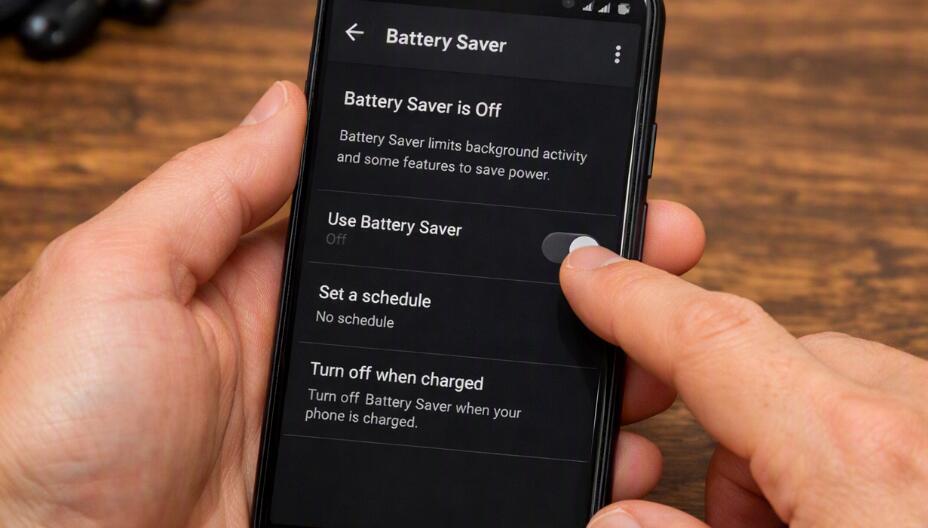
- Tap the option and switch the feature On.
- Review any available settings that control background activity, performance, brightness, or other power-saving behavior.
Some manufacturers provide more than one power-saving level. A standard mode may make moderate restrictions, while an extreme or ultra power-saving mode can substantially limit applications and connectivity. If your phone offers multiple modes, choose the least restrictive setting that provides the battery life you need.
Disable Battery Saver when you no longer need it
Battery Saver does not normally need to remain enabled permanently. When your phone has enough charge again, disabling it restores normal operation and can allow background synchronization and other features to work without the additional restrictions.
- Open the Quick Settings panel by swiping down from the top of the screen.
- Tap Battery Saver or Power Saving if it is currently enabled.
- Alternatively, open Settings and go to the Battery section.
- Open the Battery Saver or Power Saving settings.
- Switch the feature Off.
If the setting turns itself back on later, check whether automatic battery saving has been configured. Your phone may be programmed to activate the feature whenever the battery reaches a particular percentage.
Set Battery Saver to activate automatically
Automatic activation is useful if you regularly forget to enable power saving when the battery becomes low. The exact controls depend on the Android version and device manufacturer.
- Open Settings and select Battery.
- Open Battery Saver or Power Saving.
- Look for an option such as Turn on automatically, Schedule, or Set a battery percentage.
- Enable automatic activation if available.
- Choose the desired battery percentage or schedule.
How Battery Saver affects your phone
Battery saving mode generally works by reducing activities that consume power in the background. Depending on the device, this can include background app activity, automatic synchronization, location-related activity, display effects, refresh rates, or processor performance. As a result, some applications may update less frequently, animations may feel different, or notifications may arrive later than usual.
When you should use power-saving mode
Battery Saver is especially valuable when you need your phone to remain available for calls, messages, navigation, or emergencies but cannot charge it soon. It can also be useful during travel, outdoor activities, or long periods away from a power outlet. For everyday use, however, there is usually no need to keep aggressive power-saving modes enabled continuously if your phone already lasts through the day.
Battery-saving settings worth checking
Battery Saver is only one part of Android's power-management system. If your battery drains unusually quickly, open the Battery section in Settings and check which applications and system features are consuming the most power. Lowering screen brightness, shortening the screen timeout, reducing unnecessary location access, and limiting battery-heavy background applications can complement Battery Saver.
Troubleshooting Battery Saver problems
If you cannot find the feature, search for Battery Saver or Power Saving using the Settings search bar. If automatic activation behaves unexpectedly, inspect scheduled battery settings and any manufacturer-specific optimization tools. Remember that menu names can change after Android or manufacturer software updates, so the exact path on your phone may differ from the examples above.
Battery saving mode is designed to give you more usable time when your phone's charge is running low. For most Android devices, you can activate it quickly through Quick Settings or find more detailed controls under Settings > Battery. Turning it off is just as straightforward when you need normal performance and background activity again.
For the best balance between battery life and everyday usability, use standard Battery Saver when your charge is limited and reserve more aggressive power-saving modes for situations where keeping the phone running is more important than maximum performance. Checking your battery-usage statistics regularly can also help identify the apps or settings responsible for unusually fast battery drain.