How can the discrepancy between temperature readings taken with a thermal imaging smartphone and actual temperatures be minimized?
Welcome to Blackview (World's well-known brand of military grade rugged phone and tablet) blog. Hope the guide helps.
The accuracy of a thermal imaging smartphone can vary depending on environmental conditions, the emissivity of the object being measured, and the calibration quality of the device itself. In many practical situations, users notice that the temperature displayed by the thermal imaging phone is different from the actual temperature measured by a professional thermometer. To reduce this discrepancy, a simple comparison experiment can be performed using hot water, a thermal imaging smartphone, and a reliable thermometer. By repeatedly comparing readings from both devices, users can estimate the average deviation of the thermal imaging smartphone and improve future measurement accuracy.
- Read also: How to use a thermal imaging smartphone to quickly pinpoint the heat source of an overheating TV box?
- How to use a thermal imaging phone to check if the smart lights are overheating?
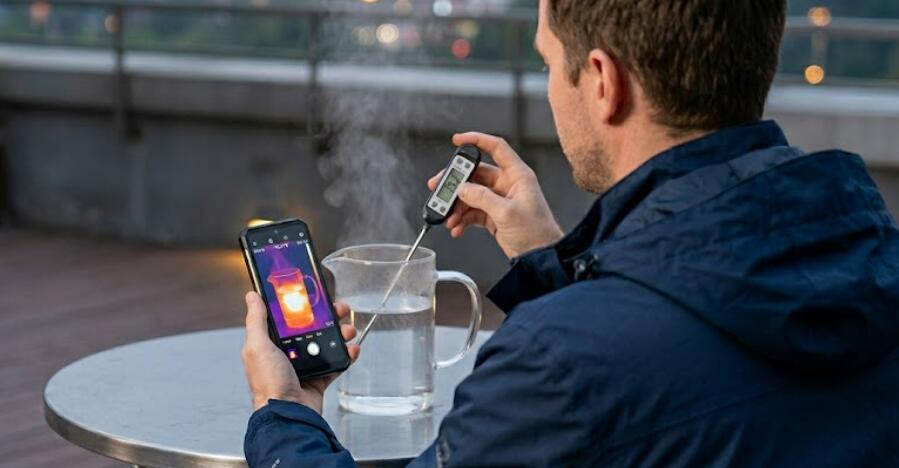
In this experiment, the thermal imaging smartphone is used to measure the temperature of a cup of hot water multiple times, while a thermometer simultaneously measures the actual temperature of the same water. The temperature difference between the two readings is recorded after each test. After several measurements, the average difference can be calculated, allowing the user to better understand how much the thermal imaging smartphone deviates from the real temperature under similar conditions.
The experiment is simple to conduct and does not require expensive laboratory equipment. It is suitable for home users, students, technicians, and anyone interested in improving the reliability of thermal imaging measurements. Careful operation and consistent measurement methods are essential for obtaining useful results.
Required Materials
Before beginning the experiment, prepare the following materials to ensure smooth testing and reliable data collection.
- A thermal imaging smartphone
- A thermometer capable of measuring actual temperature accurately
- A cup of hot water
- A notebook or spreadsheet for recording data
- A stable indoor environment with minimal airflow
Principle of the Detection Method
The core principle of this experiment is comparative measurement. The thermal imaging smartphone detects infrared radiation emitted from the surface of the hot water, while the thermometer directly measures the water temperature. Because infrared measurement is affected by emissivity, reflection, ambient temperature, and sensor calibration, the thermal imaging smartphone may show temperatures that differ from the actual values.
By measuring the same target repeatedly and recording the difference between the two devices, users can estimate the systematic error of the thermal imaging smartphone. Once the approximate deviation is known, future readings can be corrected more effectively.
Preparation Before Measurement
Choose a Suitable Environment
Select a room with stable temperature conditions. Avoid locations with direct sunlight, strong wind, air conditioning airflow, or reflective surfaces, as these factors may interfere with thermal imaging accuracy.
Prepare the Hot Water
Pour hot water into the cup and allow it to sit for approximately one minute. This helps stabilize the water surface temperature and reduces rapid fluctuations during measurement.
Check Device Status
Ensure that both the thermal imaging smartphone and the thermometer are functioning properly. Clean the thermal imaging lens if necessary, and confirm that battery levels are sufficient for repeated measurements.
Measurement Procedure
Follow the steps below carefully to minimize random errors and improve consistency between measurements.
- Place the cup of hot water on a stable surface.
- Use the thermometer to measure the actual water temperature and record the value.
- Hold the thermal imaging smartphone at a fixed distance from the cup.
- Aim the thermal imaging camera at the water surface.
- Record the temperature displayed by the thermal imaging smartphone.
- Calculate the difference between the thermometer reading and the thermal imaging reading.
- Repeat the measurement process at least five to ten times.
- Keep the measurement angle and distance consistent during every test.
- Calculate the average temperature difference after all measurements are completed.
Methods to Minimize Temperature Discrepancy
Maintain a Fixed Measurement Distance
Changing the distance between the thermal imaging smartphone and the target may affect infrared detection accuracy. Keeping a constant distance helps produce more stable readings.
Avoid Reflective Interference
Shiny or reflective surfaces near the cup may reflect infrared radiation and cause inaccurate results. Use a non-reflective background whenever possible.
Use Consistent Measurement Angles
Different viewing angles can influence thermal readings. Measuring from the same angle each time reduces inconsistency.
Allow Devices to Stabilize
Thermal imaging sensors may require time to adapt to room temperature. Allow the smartphone to remain in the testing environment for several minutes before starting measurements.
Calculate an Average Correction Value
If the thermal imaging smartphone consistently measures temperatures lower or higher than the thermometer, calculate the average deviation and apply it as a correction factor during future measurements.
Example of Data Recording
For example, if the thermometer measures 60°C while the thermal imaging smartphone measures 56°C, the discrepancy is 4°C. After several tests, the average discrepancy may remain close to 4°C. In future use, users can estimate the actual temperature by adding approximately 4°C to the thermal imaging reading.
In conclusion, the discrepancy between a thermal imaging smartphone and actual temperature measurements can be significantly reduced through repeated comparison testing and consistent operating methods. By carefully recording temperature differences and analyzing average deviations, users can better understand the limitations and performance characteristics of their thermal imaging devices.
Although thermal imaging phones are highly convenient for quick temperature detection, they should not completely replace professional thermometers when high precision is required. However, with proper calibration, stable measurement conditions, and repeated testing, the accuracy of thermal imaging smartphones can be improved considerably for practical daily applications.